
Spoilers for the Sailor Moon franchise
The romance genre is a fascinating thing. It’s definitely the most common genre out there. You’d be hard-pressed to find a series that doesn’t even hint at a romantic subplot.
It makes a lot of sense, really. In real life, romance and love are often a surprise. Love often shows up in all sorts of strange and unexpected places.
Which makes the tropes of the romantic genre a bit ironic. Because of their tropes, romance stories are incredibly predictable. When you start an enemies-to-lovers tale, you know the story’s direction. When you dive into a fake dating romance, you already know where the tide takes you. Unless it’s framed as a tragedy, the ending is very predictable. So predictable that a common criticism about the genre is that it makes romance boring.
But talk like that shows just how little said critic knows about the romance genre.
Most people who claim that romance is boring or repetitive have only seen romcoms. While some tell unique love stories, most are cash grabs meant to profit from copying an already successful work.
Good romances stand out for their creativity within the genre’s framework.
More Than One Way To- Wait, Why Are We Skinning Cats Anyway?
My favorite way to point out how differently similar love stories can be told is with the Sailor Moon franchise.
In the 90’s anime, Usagi/Serena and Mamoru/Darien will argue by daylight while working to fight evil by moonlight. At the start, Usagi’s crush on Mamoru’s Tuxedo Mask persona is the only acknowledged attraction, with the pair pursuing other options. Near the end of the first season, the show adds romantic tension to their interactions just in time for their secret identities to be revealed and their memories from their past lives as star-crossed lovers, Princess Serenity and Prince Endymion, to be restored.

The show decided that for Usagi, Serenity’s feelings are now her present feelings. She often declares her love for Mamoru based wholly on the fact that they were once in love in their past lives. Mamoru, on the other hand, is a little more complicated. The show seems to like breaking them up for conflict, so Mamoru is often in situations where he can’t or won’t reciprocate Usagi’s feelings. Despite their love being treated as fact, they don’t really get to be together until season 3.
The manga version devotes more time to building up the couple before their past lives are revealed. The initial setup of their meeting and arguing is the same, but soon, they shift to having more positive encounters. Their secret identities don’t stay that way long, with Mamoru catching her transforming and telling her his identity not long after. This is where they move from flirting to mutually pinning for each other. They can’t outright be together because the Senshi and Tuxedo Mask have opposing goals, but Usagi keeps his identity secrets for him, and they continue to have little meetups.
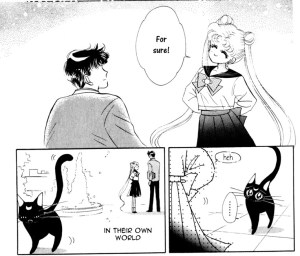
When the story tells us that Usagi and Mamoru are reincarnated lovers, their relationship is already built up enough that this knowledge doesn’t change anything about the relationship. After the arc, the couple consistently support each other on and off the battlefield. And any difficulties they had in the manga were resolved when they came together and spoke things over.
Despite both versions telling the story of two star-crossed lovers reuniting and gaining a second chance in another life, these two versions of Sailor Moon tell distinctly different love stories.
This is why romances that cover the same tropes and themes have dedicated fans. They don’t expect to open up a new book or hit play in a movie and see the same story play out. They want to know how this romance differs from all the rest.
But wait, I hear you asking. The title of this post is “Comfort in Predictability,’ so why are you talking about how stories differ? Shouldn’t you be talking about how they’re the same?
You’re right. I got distracted. Let’s get back on track.
Romance: Your Tourguide through the Unknown
Remember earlier how I said romance is the most common genre. Well, that’s true because of two reasons. The one I already mentioned is that romance often appears as a subplot, but the second reason is that it uses other genres as settings.
The romance genre’s rules take over regardless of the setting. Whether the character meets in space, a period drama, or a fantasy setting doesn’t matter. People still fall in love, so why wouldn’t their stories fall in line with what makes romance stories great. The audience still expects the main couple’s first meetings to be cute, or disastrous, or disastrously cute. They expect some form of a love triangle to rear its head. They expect the finale to contain some grand declaration of love.
It also creates a single role for the story to achieve for it to have a good ending. A romance succeeds as long as the characters love each other in the end. For other series, things aren’t so cut and dry.

It’s common to hear fans complaining about the ending of some action, fantasy, or drama series. This is because when people start the series, they have where the story is going. The only thing fueling continued investment is an interesting premise and the promise of excitement. Just look at Game of Thrones. Without going into too much detail, many fans felt that the series finale undermined character arcs, left unanswered questions, or some issues were resolved a little too neatly. The story had thousands of ways it could have ended, but as far as fans were concerned, it picked the worst one.
With romance, that bar for a good ending is far easier to meet because of the forgone conclusion. Nothing more is needed as long as the characters are happily together on the last page. That is why there is comfort in the predictability of romance. Like taking a ride share home, people may judge the way we got here, but no one is going to complain when we where we planned to go.
Well, it took me way longer to finish this than I wanted, but at least I’m done now. I wanted to include a section about the novel Kiss Her Once For Me by Alison Cochrun. Her book introduced me to some interesting angles for the genre because of how her LGBT characters interacted with the romance plot, and I thought it would be a good inclusion for Pride Month, but the post was getting way too long and off-topic. But, I did talk about Sailor Moon, where Usagi is shown to be either bi or pan in the manga, so I guess it was on theme.
Now excuse me, I have to go work on a Star Wars rewrite. Until then, peace out!

 I Think Thinks