
So, quick note, I didn’t really like the giant wall a text that was the Shipping post. While I did feel that I expressed my points well, I just prefer online texts to be shorter. I think the post will end of being a three-part series to compensate for the length. And without further ado, on to part 2!
(This section contains mentions of brief mentions of suicide, drug addiction, and sexual assault.)
Jump Cut Storytelling
Remember back in part 1 when I said that a lot of the Team’s character arcs don’t really go anywhere, well that’s not me being entirely honest. It would be more accurate to say that Young Justice main characters arcs do go places, but not when we see it.
The Team does spend time developing their own plots but at a snail’s pace. The mission of the week, the romances, and the overarching seasonal plot all take priority over the personal development of the central team.
Taking a break from personal problems isn’t a bad thing for a show, After all, it would get annoying if every episode was dedicated to Robin’s fears for his future or if Conner trying to fit in with civilians. However, pushing off the story for too long can trivialize the characters’ lives. Young Justice has a habit of having characters ignore a problem for longer than necessary and then provide a quick solution.
The five year time skip can be seen as a center point for this practice, but it’s not the only place that this problem can be felt. It would also like to not I’m not sure if the time skip was planned or not. If it was planned, the creators dropped the ball when it came to resolving plots. If it wasn’t then it makes sense that they put that stuff off. I could imagine an alternate season two that works through the characters issues.
(Before I get into to this, I’d like to point out I know there are comic books and a game that contribute to the show’s canon. However, I’m of the mindset that if I have to look at extra media separate from a show to enjoy its story better, then the show failed to properly engage me.)
Welcome to the Clone Club
We started with Roy last time, so why not keep the trend going. Roy’s plot cuts off at its beginning because of the timeskip. When it comes back in season two it’s in front of the solution.
Recap time! Season one ends with the revelation that the Roy Harper we knew was really a clone. DUN DUN DUUUNNN! Years before the first episode, the original Speedy was kidnapped by CADMUS and replaced with a clone. This discovery shakes Roy to his core. It’s clear that Roy believes he stole the life of “the real Roy Harper” and makes it his mission to find the missing Speedy.
Five years later and things aren’t looking good. With no leads, everybody else is convinced the original died, but Roy persists. The search took over his life, turning into an obsession. His relationships fall apart, His hero work suffers, and there are even implications of Roy developing suicidal tendencies and drug addiction.
And you may be asking, why do I have a problem with this storyline? For one thing, they told us all of this in just one episode, and the next time we see this plot it’s resolved.
I’d like to point out that I think they handled this plot well for this subject matter in a kid’s show, but I’m still left confused. Not only am I wonder how all the heroes around him failed to step in sooner (especially since season one shows that Black Canary is a counselor of some sort), but I’m also confused about why they bothered to do any of this.
The show throws all this plot away it the next episode that features Roy. Clone!Roy and Chesire (they also bring their baby for no reason) find and rescues the original. From this point, the story shifts to follow original!Roy as he tries to come to terms with what happened to him and the other Roy leaves the show focus o his family.
So why was any of this necessary at all? They could have cut the whole part of the story where clone!Roy life was falling apart and just started the plot where they found original!Roy since his story is obviously the one they wanted to tell here. In the end, it just felt like they wanted to fill time with a mini recap of what happened to some of the characters before saying goodbye to Red Arrow.
The Father and Son of Steel Who Never Were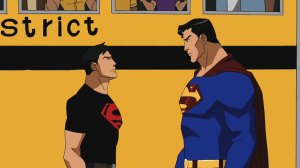
When Conner was first introduced, the writers wasted no time establishing that he was functionally Superman’s son. So when Superman rejects Conner on his first meeting, it hits Conner and the audience hard. Other Leaguers also indicate their dissatisfaction with the situation by doing little things (giving Superboy the last name “Kent” behind Superman’s back). Bruce Wayne even meets with Clark Kent to confront him about his behavior.
Later in the season, Lex Luthor reveals that he is biologically Superboy’s other dad and simultaneously revealing that Conner is a Kryptonian-human hybrid. Luthor offers support for Superboy in the manipulative underhanded way that he’s known for. Superboy desperate for approval accepts Luthor’s help. (This opens up a storyline about Superboy using, a pretty obvious, metaphor for steroids that Lex gave him, but I’ll talk about that in the next section.)
It is easy to watch the show and pick up the Superman-is-a-deadbeat plot. Superman’s reluctance to take care of his “son” understandably is crushed Conner, causing him to develop some anger management issues and a tendency to trust shady businessmen.
Now I could get on board with this storyline if not for a couple of facts.
Mixing Metaphors and Muddying Waters
This first thing is something that I am almost entirely sure was an unintended read on my part. I don’t believe that the writers expected me to read it this way, but there is always the risk of mixing when you deal with metaphors.
Drawing parallels between fantasy scenarios and real-world situations have always been a balancing act. You need to make sure there are enough connecting points for your audience to make the connection while being on the lookout for unintended connections that some of the audience might make observing your analogy. While the creators of Young Justice succeeded at the first step, they failed at the second.
Let me give another slightly different recap of Superboy’s creation to highlight what they didn’t account for. CADMUS and Lex Luthor steal Superman’s genetic material with the express purpose of making a child. This eventually leads to Lex donating his own genetic material to the project. And so, without the knowledge or consent of Superman, Conner is born. Upon discovering this violation, Superman rejected the boy.
When I put it like that it doesn’t take the world’s greatest detective to see the unfortunate parallels between Superboy’s creation and sexual assault. And that changes some things for viewing the show.
In this light, it’s hard not to understand Superman feeling a bit overwhelmed by the situation. This subject matter would be difficult to handle in adult media, let alone in a kid’s show.
Though I’m not going to kid myself into thinking the writers wanted me to think this for a second, I couldn’t divorce myself from this headcanon, and it hurt my ability to enjoy the show.
Here’s how I’m sure this wasn’t what the writers intended. Whenever Superman is brought up in the first season, it is either other characters making it clear they don’t approve of his actions or Superboy having clear emotional developmental problems stemming from Superman’s neglect. There is never a moment where any character points out that because Superman didn’t consent to the act that created Superboy, he didn’t necessarily have a responsibility to raise the kid either.
And if there were ever any question of whether or not this was intended, the lackluster resolution makes it clear that the deadbeat dad/secret clone was never intended to be read like this.
Jumping to Conclusions
Speaking of the resolution, how did this storyline end? Well, season one ends with Superman finally reached out to Conner. The first step in the right direction, but then the timeskip happens. The next time we see these characters together they’re calling each other … “brother.” Wait, what? How did that happen?
I want to briefly point out that in DC’s main canon Conner and Clark had a brotherly bond. Conner lives in Smallville with Ma Kent (Pa has passed in the comics I read) and was publicly recognized, like Supergirl, as the cousin of Clark Kent. Clearly, the creators of Young Justice chose to mimic the comics in an attempt to resolve the conflict between Supers.
However, the creator made it clear that when you see Superman and Superboy they want you to think father and son. They have Aqualad say that Superboy is Superman’s “son” as early as episode one, and a few episodes later, Batman tells Superman that he needs to step up as Superboy’s father. Even Lex Luthor outright calls Conner his son.
So, why did that change?
I suspect that the father-son connection was done as an experiment more than anything. I know that some comic fans had problems with the brotherly role Clark took in Conner’s life. I even remember joking around with other comic fans that Superboy was Superman’s and Luthor’s lovechild. I guess the writers thought “Why not try this idea?” and that how the first season dynamic between the Supers was born. Unfortunately, they weren’t really committed to the idea for the long run.
As soon as the plot took one step towards a resolution, it was abandoned. Instead of walking the audience through the complicated process of building a relationship, they fell back on the comic canon that now had no place in their version of the story. What was once the backbone for Superboy’s character was handled like a minor conflict. This is why I suspect that so many Young Justice fans still have grievances with this version of Superman.
Not only did the brotherly relationship feel like a consolation prize for the strife that Superboy faced all season, but because they don’t have much screen time together, we are also shown very little its results. This is why “show, don’t tell” is so important. Fans had trouble connecting with the change because of the suddenness. If we were shown the growth, more I would have been more on board with this change.
Consequences? What Consequences?
At the end of the day, the biggest thing that bothers me about the show is how they drop a storyline at the most minor solution. Look at the steroids subplot for example.
When Superboy was first awakened from his cloning pod, he was shocked to discover that he didn’t have all the powers that Superman has. No heat vision. Not flight. Nowhere close to the Superman he was created to replace.
Earlier when I said that Superboy’s anger issues stem from Superman’s neglect that wasn’t exactly honest. Although Superman’s rejection doesn’t really help matters, it’s more of a contributing factor to the problem.
It would be more accurate to say that Superboy’s anger issues came from the fact that he isn’t a perfect clone, but a Kryptonian-human hybrid, and thus, doesn’t have the same powers as the original Superman. (Also, it isn’t clear if the Superman in this series always had all his powers or if he developed them with age, and if the latter were the case, he might have been able to sooth some of these insecurities if he accepted Conner sooner.)
So when Lex Luthor offering “shields” that will unlock Conners latent Kryptonian power, he takes them, kickstarting a mini-arc. Everytime Conner uses the shields, he gets stronger but also angrier. When his friends ask about his new powers, he lies to them. Afterall they would insist he stop using something given to him by Lex Luthor, but he needs them to be strong enough to help the Team. But then, he runs out of shields.
So what happens next? Does he go to Lex and end up in a dubious alliance? Does he start going through withdrawal symptoms? Does this have any lasting effect on his hero work? Nope!
Superboy just tells his friends what’s up and it’s over. And that’s when I noticed the trend.
Remember how I mentioned that clone!Roy seemed just fine as soon as they found the original. That wasn’t an exaggeration. There was no lasting damage from his downward spiral. The same with M’gann insecurities about being a white martian (in some ways it feels like the writers forgot about it). And Aqualad’s regrets about leaving Atlantis are gone after one home visit.
With this show, a resolution means the story there is over. No loose ends. No lasting consequences. Just the quickest possible conclusion then it’s done.
Maybe they’ll fix this problem in season three, but at this point in my life, I don’t really see myself watching it.
In the next and final part, I’m gonna talk about the biggest disappointment I had with the series.
*All images used came from the Young Justice Wiki

 I Think Thinks